
History of the Trust
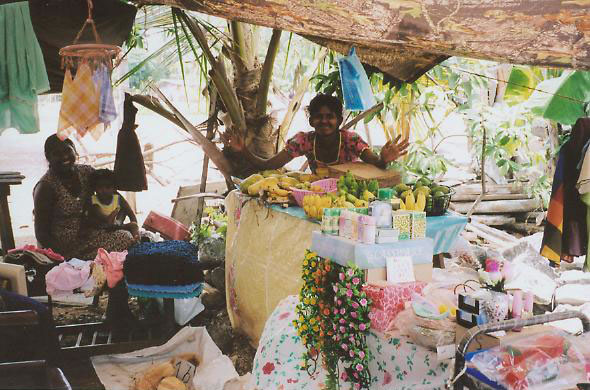
Vesak market in Samarakoon Watta.
In 1997, utilising her community-based experience in the country, Juliet Brown travelled to Sri Lanka in order to establish a new charity working with the children of Sri Lanka. The vision was to establish a charity that would be different from the large aid organisations, where the aim was to reach children, families and communities that would otherwise be unable to gain assistance.
Having developed the concept and gained support from the authorities and other aid agencies working in Sri Lanka, Juliet returned to the UK to register a charity and begin building the UK organisation. She set up a board of Trustees and in February 1998 the charity was officially registered as Shining Life Children’s Trust.
Field director
To oversee Shining Life Children’s Trust’s work in Sri Lanka we employ a volunteer Field Director. Our first Field Director travelled to Sri Lanka in August 1998. For this position we chose someone who had already worked as a volunteer in Sri Lanka. His knowledge of Sri Lanka soon earned him the respect of others working in the field and he quickly built a network of high-level contacts within government organisations and other aid agencies. Juliet travelled again to Sri Lanka and together they developed a full proposal for how the newly formed charity should work.
Agreement of working proposal
In April 1999 the Trustees agreed this proposal. The central concept to the proposal was that Shining Life Children’s Trust should always be working to ensure sustainability rather than dependency. To this end it was planned that we should work on a series of projects, each project would be run in partnership with a local Sri Lankan organisation for a three year period. The three year time period would enable us to provide funding and professional input to help the local organisation and the community develop skills and carry on the project work without international support after three years. Also crucial to ensuring sustainability would be the involvement of community members in all aspects of the project from planning what would most benefit them in their everyday lives to evaluating the success of the project. Poverty has multiple causes and results in a wide range of problems; to this end each project would be multifaceted, working to tackle all areas identified as needing support by the community. Finally the strengths of Shining Life Children’s Trust lay in the newness of the organisation and succinctly defined aims. It was therefore agreed that the projects we would support should be new, small and self-contained projects that would not attract funding from larger organisations.
These five aspects continue to direct and define the work of Shining Life Children's Trust:
- Partnership working
- Defined period of support
- Community involvement at all stages
- Multifaceted approach
- Small communities
The first projects
Shining Life Children's Trust has now worked with six different communities facilitating a wide range of projects. Our first two projects began in 2000.
The first was in Matale, central Sri Lanka, providing home-based child care and nursery education to the pre- school children of a scattered rural community. The partner, SITHUWAMA, was well established and so we were able to learn from them as well as them from us. The second project was in Moratuwa, a coastal shantytown. Here, the local community wanted to work with teenage mothers and equip them with skills, education and support to build a brighter future.
Following the completion of these projects Shining Life Children’s Trust moved on to identify two more communities that we could assist. Our third project was again in Moratuwa working with a shantytown community to improve child nutrition, living conditions and earning potential of the community members. The fourth was in Kalpityia, North West Sri Lanka, working with several, mainly Muslim, villages to provide pre-school education and micro-lending schemes.
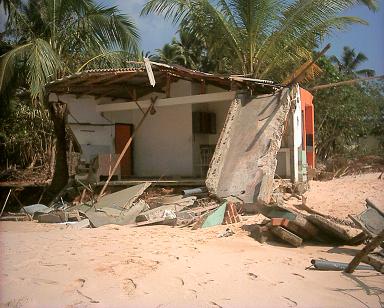
Building devastated by the tsunami.
Boxing day tsunami
Shining Life Children's Trust Field Director Raja Dasgupta, was working well with our partners in assisting these communities to improve their lives when disaster struck on December 26th 2004. The Tsunami, as has been well documented, had a devastating impact on many communities within Sri Lanka and as a result created even more need for the type of work Shining Life Children's Trust undertakes. Raja fulfilled a very valuable role immediately after the Tsunami in facilitating aid distribution and then identified a particular fishing community in Telwatta that really needed our help. For the first time Shining Life Children's Trust grew to support three communities simultaneously.
We worked with another community in Uplands in the central highlands area home to many tea plantations. Working with a team of teachers from the local school we helped them to construct a community play area.
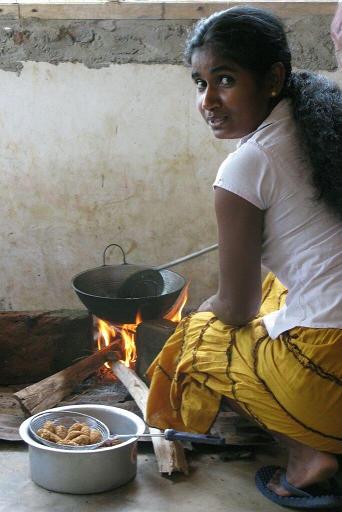
Food preparation training in Galewala.
At the same time, Shining Life was working with two other communities – one on the Rahuntagoda Tea Estate near Rikillasgaskada, east of Kandy, and the other on the north central plains near Galewala. In 2010, we started a new project working with three disparate communities in the Kandy District. We worked with the Women’s Development Centre in the Kadugannawa, Ulapane and Pupuressa areas of Kandy District.
Following the end of the 30-year conflict, SLCT has worked solely in the Central Provinces of Sri Lanka that contain many resource poor villages and the majority of the tea estates in Sri Lanka. Most recently Shining Life has worked with the Rahatungoda Tea Estate in Nuwara Eliya District and has also completed a three-year project in the Galewala Division of Matale District working in the villages of Meewalapataha, Ibbankatuwa and Thalakiriyigama supporting Children’s Clubs, income generation activities and micro credit savings schemes. In 2013 we completed the project working with the Women’s Development Centre.
Current projects
SLCT currently has one project running. We started a new project in October 2013 in the Galewala Division working with three villages with our long-term partner the Human Development Foundation. This project will run until March 2016. We are also aiming to start a new project during 2015.
Since the Boxing Day Tsunami seven Field Directors have worked for the Trust, each bringing their unique skills to the organisation and helping to develop and nurture our projects with a diverse range of Sri Lankan communities.
As is evident Shining Life Children’s Trust is continually developing. Back in the UK, the Trust is run by a dedicated group of seven Trustees. Our main aim is to raise funds in order to support the work in Sri Lanka. The small size and uniqueness of the Trust means that those who support our work feel personally involved.
The future
Looking to the future we will continue to identify and partner with vulnerable communities with whom Shining Life Children’s Trust can undertake valuable work. However, we do not want to lose site of the many benefits of being a small organisation; our intention is therefore to continue to undertake comprehensive projects with just a few communities at any one time.